While evaluating some oddly-shaped parcels, some potential floor plan arrangements for a cohousing residence were sketched out. These were made to achieve certain objectives within very cramped build envelopes.
These are just rough concept sketches. At best they are a starting point for an architect (that architect should also be involved in polycrisis response planning). There are numerous more-complete designs, such as cohousing buildings from One Community and cold-weather earthship designs from Bio-Veda.
Objectives
These designs have some particular objectives, many of which accommodate a cold-winter climate:
- Enable passive solar orientation (facing toward the equator) for all residences and commons.
- Enable interior access to all parts of the building. In inclement weather, residents can still travel easily between their residence and the commons.
- Provide a kitchen greenhouse (for herbs, out-of-season greens, etc.) that can be accessed from indoors, near the kitchen.
- Provide individual residences that are similar to full apartments, minus the kitchen. (These designs could accommodate a small kitchenette in each residence’s lounge.)
- Allow residents to enter/exit privately, without needing to go through the common room.
- Enable modular expansion. These designs can continue to grow by adding additional residences. Also, doors may be placed between residences to merge them into larger residences.
- Provide an optional large, heavily-planted sunroom. Designed for four-season climates, to enable an “outdoor” experience in winter.
- Provide a large common room where people can spread out, but also provide a study or quiet room.
While the residences could accommodate small kitchenettes, those are not included in these designs. The Integration Center Curriculum is centered around a collective food process, which includes sharing meals.
These sketches were inspired by the groundbreaking Bio-Veda Earthship designs, which are thoroughly engineered for regenerative living but are not yet to the scale of a unified cohousing building.
Again these are just non-architectural concept sketches. They are not to scale and are not engineered. At best, they serve as a starting-point for an architect.
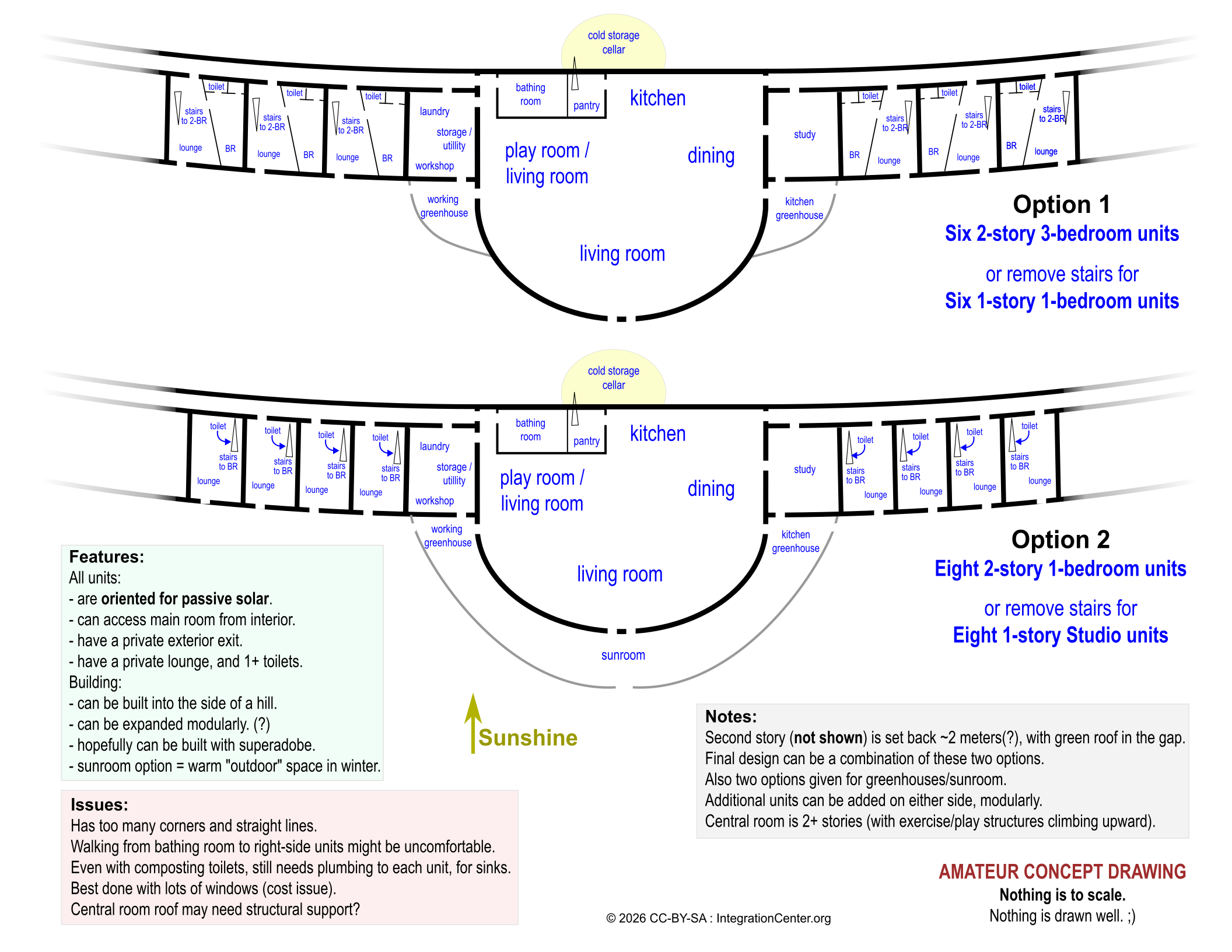
Wings House
This design was conceived to be built along a ridge of a hill. The back of the house is intended to be buried into the hill, meaning the back hallway is windowless. This design can continue to expand horizontally, along either wing.
This sketch shows two different conceptions of the first floor. There is a second floor which is not shown, containing additional bedrooms for the units. The second floor can be omitted, making the entire house on the same level.
Stacked House
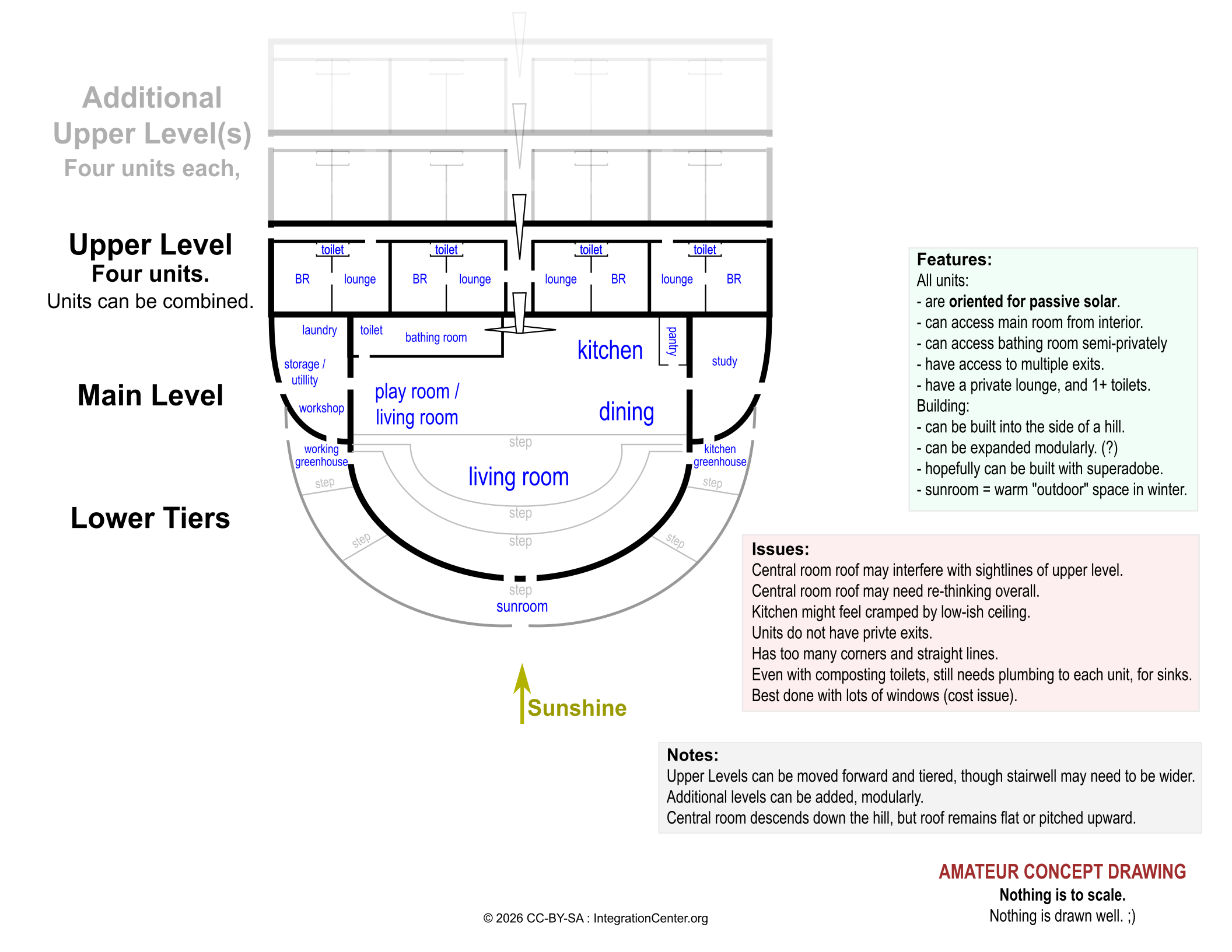
This design is also meant to be built into the side of a hill. The steeper the hill, the more that the upper levels can be brought forward. This design can continue to expand in depth, with additional levels going behind and above the main level.
This design may accommodate ramps between levels and also on the exterior, descending from the hallways. Additionally the indicated steps in the living room and sunroom can easily accommodate ramps.
Tightly-Stacked House
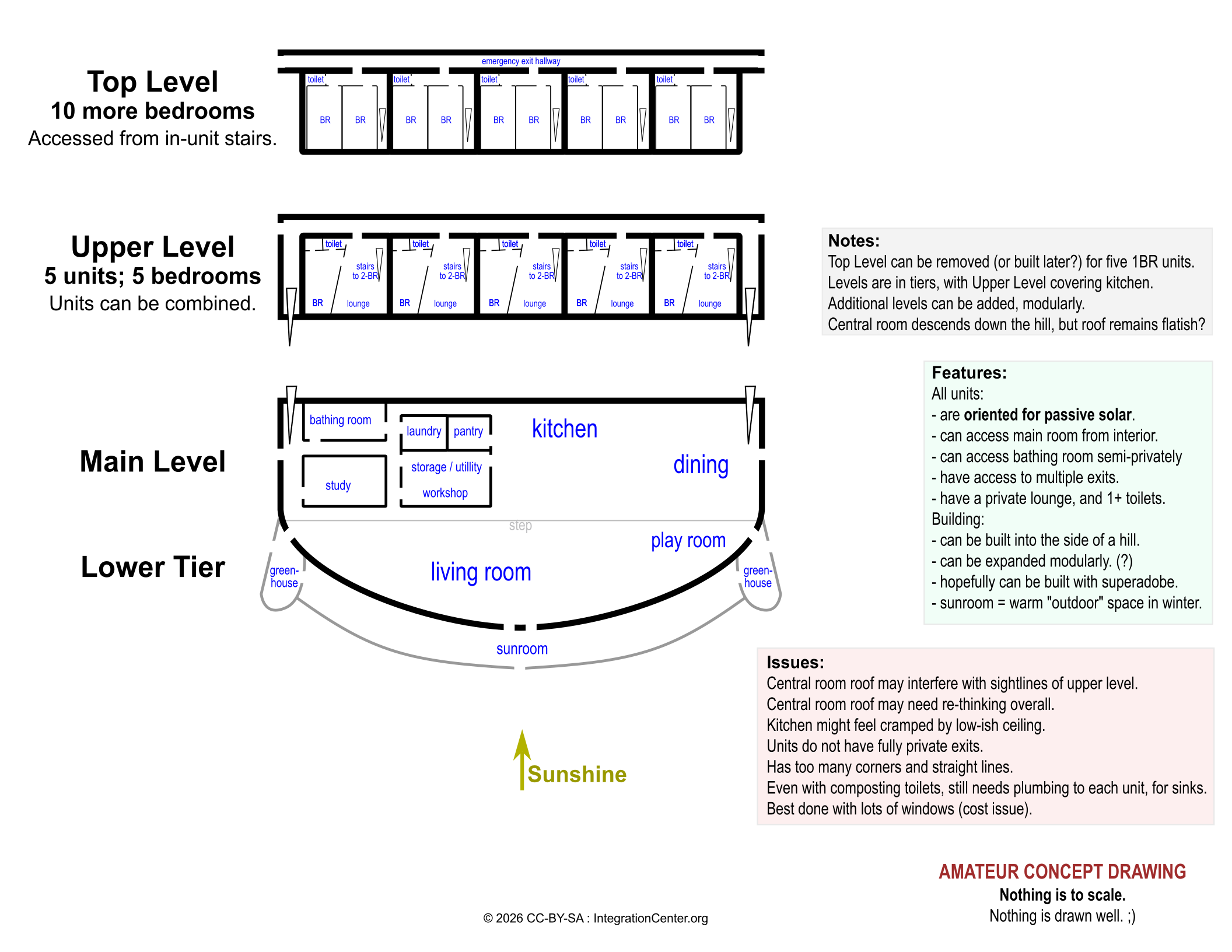
This is a variant of the above, intended to fit more units into a denser space.
While achieving those objectives, this design is more difficult (though not impossible) to expand modularly.
This design also is less adaptable to ramps and so may be less accommodating to people with limited mobility. However, each floor has an exterior exit, and might be accessible by exterior ramps.
As Project 1 continues to evolve, more detailed information will be added to this page.
Return to: Open Business Plan
Further reading: Evaluating Parcels